

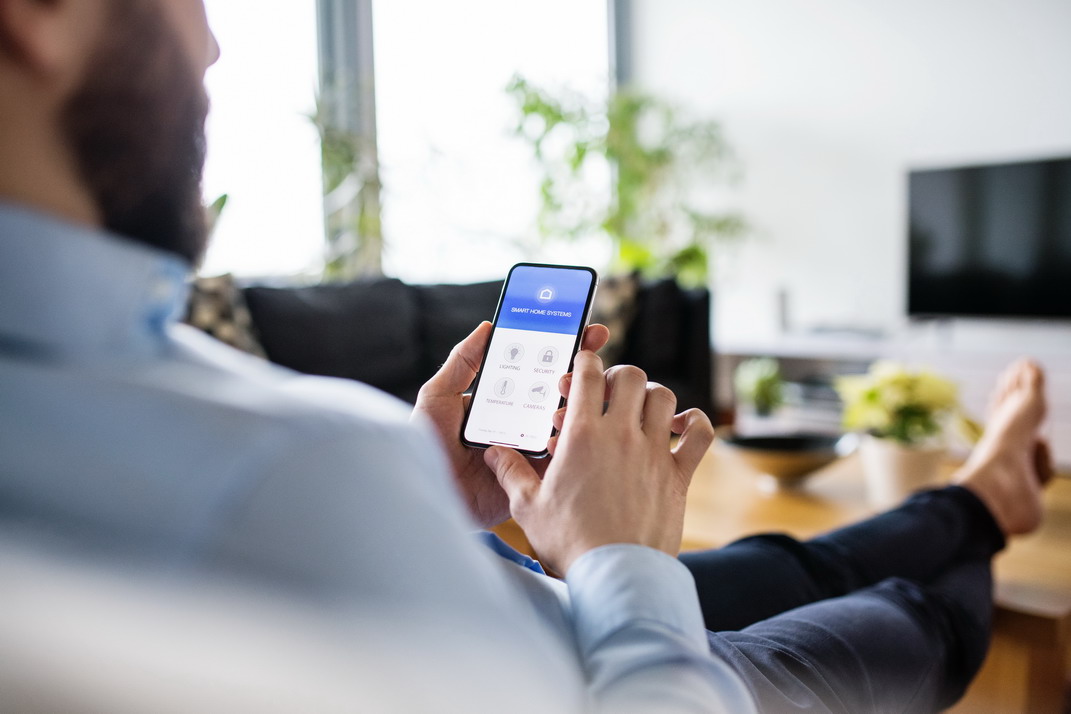
Electronic home security existed long before there was an internet. System control was managed through a centralized hub normally represented as a panel attached to the wall. Things are a lot different today. People now control their home security systems with mobile apps. In fact, full mobile app control has become a staple of modern home security.
Mobile out control is central to the modern security environment because it turns a passive, fixed system into an active system a homeowner can control and monitor from virtually anywhere. More importantly, control and monitoring occur in real time.
A bonus is that mobile app control facilitates more modern security expectations, like integrating home security with smart home automation. The mobile app has made home security more user-friendly and, as a result, now drives a significant portion of the smart security market’s growth.
Table of Contents
Remote Control Offers Convenience
Being able to control one’s home security system remotely is the epitome of security convenience. Take the Vivint HomeProtect system. It can be controlled entirely through the Vivint app. There isn’t a more convenient way to arm or disarm a system, check video feeds, and manage automated lighting.
Arm and Disarm on the Go – Arming and disarming a system by way of a centralized hub requires being present. But with a mobile at, one can arm and disarm on the go. Think of the implications. Forgetting to arm the system is no longer a problem. Ditto for remotely giving guests access to your home.
Maximum Protection – Forgetting to own a security system in the 1970s meant leaving your home unprotected until you returned. But those days are long gone. Homeowners now enjoy maximum protection by being able to arm from anywhere.
User-Friendly Control – First-gen home security hubs were almost as confusing as VCRs in programmable thermostats. Today’s home security is much more user-friendly thanks to the mobile app. What used to feel like a complex task is now simple and natural.
The mobile environment is one that is familiar to most of us. It is also an environment we have come to rely on for convenience. For that reason alone, complete mobile app control is a mainstay of modern home security.
Real Time Awareness and Response
Complete mobile app control offers real-time benefits in terms of awareness and response. Going back to Vivint’s HomeProtect platform, it can be had with or without professional, 24-hour monitoring. Without monitoring, a consumer still enjoys real-time awareness by way of instant push alerts. Alerts are sent whenever the system triggers an alarm.
Real-time awareness leads to faster responses. Throw in 24-hour monitoring, and a homeowner has an extra set of eyes and ears being made aware whenever an alert is triggered. Now both the monitoring center and the homeowner have the opportunity to respond.
Home and work day-to-day routines are enhanced by real-time awareness as well. Think of live video streams. A homeowner can check his video cameras to make sure his pets are behaving themselves. Live video streams let him know the kids have arrived home safely and are busy doing their homework in the dining room.
Homes equipped with high-end cameras offer the benefit of two-way communication through the devices. Using the app, a homeowner can communicate with his kids or remind the dog to stay out of the garbage – all in real time.
Smart Home Integration
Moving beyond simple home security, full mobile app control is the perfect solution for integrating security devices with a home automation system. A mobile app turns automated lighting from a mere convenience into a security tool. The same app can control smart locks, security sensors, thermostats, lighting, and everything else in the system.
In addition, automations can be coupled with security strategies. For example, a system can be programmed to automatically turn on lights when certain motion sensors are triggered. The cascading event sends an immediate push notification to the homeowner’s phone. The homeowner can then check video feeds to determine whether or not something is amiss.
Perhaps the most exciting aspect of home automation integration is turning a smartphone into a geolocation device. The phone and its app become triggers for all sorts of automation and security events. The perfect example involves a security system and a smart lock.
With geolocation, a system can be programmed to respond based on the location of the homeowner’s cell phone. As the homeowner leaves for work at the start of the day, the front door automatically locks, and the security system is armed. Talk about convenience!
The Personalization Factor
If full mobile app control needs the proverbial ‘icing on the cake’, it would be the personalization factor. Mobile phones are incredibly flexible in terms of delivering notifications based on a user’s preferences.
A mobile app lets a homeowner customize notifications for all sorts of events. Certain events can trigger notifications, while others are ignored. Not only that, but notifications can also be personalized in terms of message content, alert sounds, and recipients.
Mobile app personalization also encourages establishing and managing multiple user profiles for each member of the family. Mom and Dad can have one profile while the kids have another. Out of town guests visiting for a short amount of time can be given a temporary profile with a unique access code. Meanwhile, profiles can be managed and modified remotely.
Still Room for That Keypad
Full mobile app control is a key feature of the HomeProtect platform. It is something that most home security providers have embraced as well. But that does not mean the traditional keypad is out. There is still a place for the keypad mounted on the wall near the front door. The keypad acts as a secondary controller in case a homeowner needs to do something while his phone is handy.
A lot has changed in home security over the last 50 years. Perhaps no change has been more profound than the introduction of full mobile app control.
