

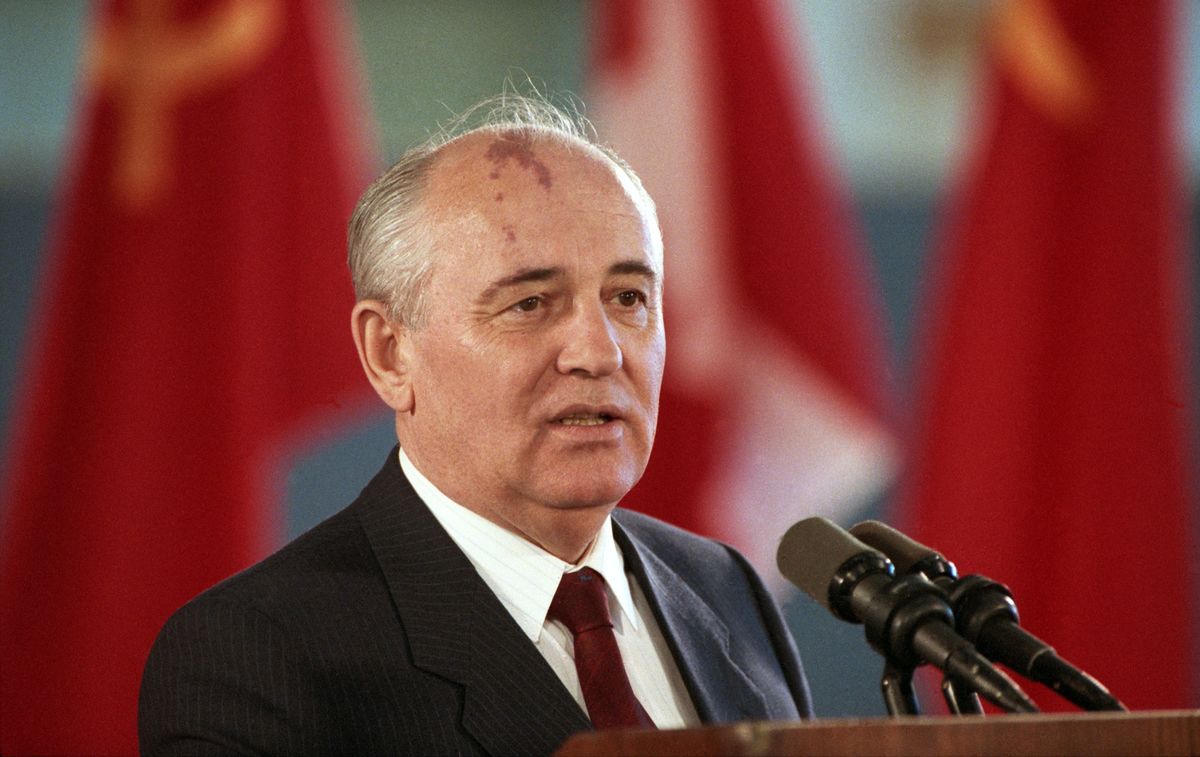
Mikhail Gorbachev, cold war leader, dead at 91. Former Soviet leader Mikhail Gorbachev, whose reforms precipitated the unexpected dissolution of the Soviet Union and the fall of communism across central and eastern Europe, died at the age of 91 in Moscow.
Hospital officials were quoted by Russian news outlets on Tuesday as stating that Gorbachev, who won the Nobel Peace Prize in 1990, had passed away following a “difficult and protracted illness.”
The first and final president of the Soviet Union, Gorbachev led the country to its demise. In 1985, at the young age of 53, he was elected general secretary of the Communist Party, a position he retained until the party’s dissolution in 1991 and the subsequent collapse of the Soviet Union.
He will be remembered for his efforts to bring the Soviet Union into the contemporary era. His policy of perestroika (or restructuring) was meant to revitalize a stagnant economy and usher in new conditions. After decades of government deception and censorship, glasnost, or openness, was introduced.
History’s lost hero: a profile of Mikhail Gorbachev in the Observer
Gorbachev initiated detente with the West in addition to domestic change. He lived to see the end of the thaw when Vladimir Putin invaded Ukraine and Russia once again became an international pariah. He avoided making any public statements about the conflict.
However, Alexei Venediktov, a friend and the former leader of the Ekho Moskvy radio station, said privately that he was “upset” and implied that his “life’s work” had been “destroyed.”
Ultimately, Gorbachev’s refusal to resort to violent measures is what led to him being awarded the Nobel Peace Prize. Forsaking the Brezhnev theory, which held that Warsaw Pact client states were subject to repression from Moscow, he abandoned the bloc.
During a 1984 Soviet parliamentary tour to the UK, he famously got along with Margaret Thatcher. It was fun for Thatcher to meet with Gorbachev.
Thatcher, speaking of Moscow’s new, upwardly mobile premier, stated, “We can do business together,” following a string of short-lived gerontocrats. The two men became close, and in 1986 Gorbachev agreed with Reagan to lower the number of medium-range nuclear weapons in Europe. When the Soviet Union’s disastrous involvement in Afghanistan continued for another two years, Gorbachev eventually pulled out his soldiers.
And in the summer of 1989, he declared that Communist nations could do anything they wanted within their own borders.
This occurred in a wave of relatively bloodless revolutions that swept across Poland, Hungary, east Germany, the Czech Republic, and Romania. At home, Gorbachev battled separatist claims from the Baltic States, Azerbaijan, Armenia, and Georgia, all of which were part of his empire. The bloodshed was greater in this one.
The communist party’s power began to dwindle around 1990–1991. When hardliners in the Soviet Union attempted to halt the country’s impending collapse, Gorbachev’s own position began to weaken as a result. When Gorbachev went on vacation to Crimea in August 1991, ultra-conservatives took over the government in a coup. For three days they were in control.
It was Boris Yeltsin, the newly elected president of the Russian Federation, who put an end to it. While in government, Gorbachev oversaw the swift dissolution of the Soviet Union as a republic after republic, including Ukraine, voted for independence. He remained in office until late 1991. On December 27th, he decided to leave politics.
Liberal economist Ruslan Grinberg visited Gorbachev in the hospital on 30 June and later said, “He gave us all freedom – but we don’t know what to do with it.”
After leaving power, Gorbachev established Green Cross International to address the nuclear waste and environmental damage left behind by the cold war. He made several attempts to return to politics, including a run for president in 1996. There was no success at all.
Despite the fact that Soviet hardliners were ultimately defeated, their apprentice, an unfriendly ex-KGB spy named Vladimir Putin, was sitting pretty in the Kremlin by the year 2000. There was tension between Gorbachev and Putin. Putin’s revisionist foreign policy, including Russia’s war in Georgia in 2008 and the annexation of the Crimean peninsula in Ukraine in 2014, has his stamp of approval.
However, Gorbachev disapproved of Putin’s gradual and methodical suppression of civil society. He made numerous memorable remarks in which he accused him of blatant authoritarianism and of turning the United Russia party into a poor imitation of the Communist Party. Putin “thinks that democracy stands in his way,” Gorbachev remarked of him in 2010.
Russia’s official news outlets, meanwhile, portray Gorbachev as an antagonist. Putin called the fall of the Soviet Union “the greatest political catastrophe of the 20th century,” and he has been presented in the media as a CIA stooge and the man responsible for that collapse. There have been whole stretches where it completely disregards him.
After the death of his wife Raisa to cancer, Gorbachev spent his final years as an ardent charity advocate, making him a somewhat contradictory image. Overseas, people hailed him as a hero for his role in ending the cold war and ushering in a more liberated era. In Russia, he was widely despised and viewed as a traitor at best and an unperson at worst.
